The art
What is Sanjhi?
A centuries-old temple art of cut-paper stencils from the land of Krishna, and the craft Jaishree Pankaj has spent her life refining.
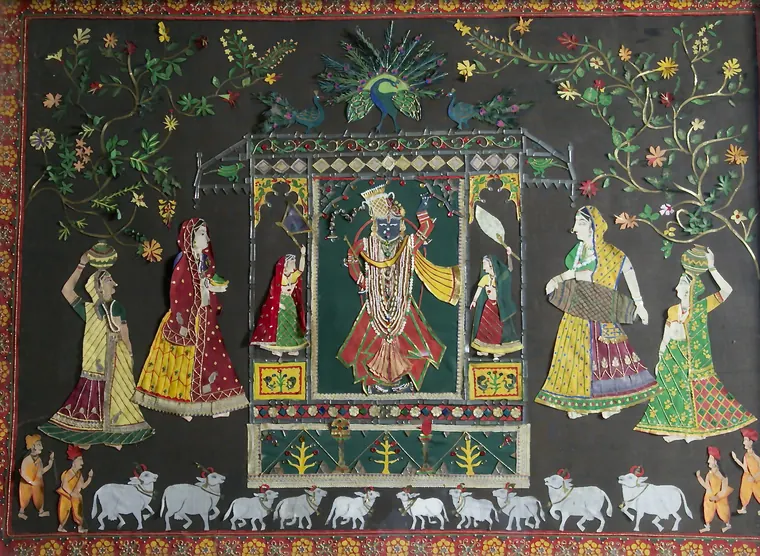
Born at dusk
The word Sanjhi comes from sanjh, dusk. In the temples of Braj, the country of Krishna around Mathura and Vrindavan, Sanjhi was made in the evening during the Bhadrapad season. Tradition says Radha made the first one, arranging flowers at twilight to delight Krishna.
Stencils were laid on the floor before the deity and dry colour was sifted through them. What remained were pictures of Krishna’s leelas, flowers and borders. By morning they were swept away, and a new one was made the next evening.
From banana leaf to paper
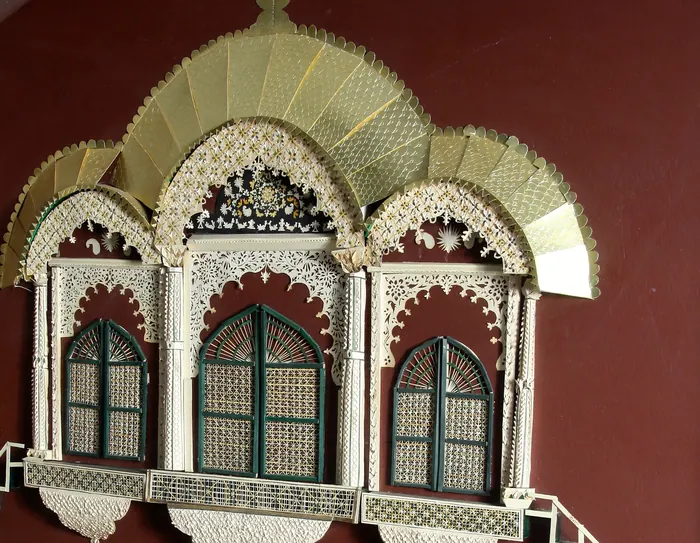
The first stencils were cut from banana leaves. Paper took their place, and the designs grew finer: creepers, peacocks, and the trellis patterns of the stone jaalis in the Vaishnav temples of Gujarat and Rajasthan.
In the Pushtimarg tradition
Sanjhi is part of the seva in the havelis of the Vallabh tradition, whose heart is Shrinathji at Nathdwara. Jaishree’s family belongs to the Vallabhkul. As a girl she watched her grandfather cut scenes of the Krishna Leela, Raas Leela and Govardhan Leela to decorate Shrinathji’s swing.
Her way of working
From stencil to work of art
Traditional Sanjhi is a tool: the stencil makes a picture, then it is put away. Jaishree keeps the paper itself as the finished work.
No drawing
She does not sketch. The design is in her mind, and she cuts it straight from the sheet.
Only scissors
A small pair of scissors does everything, from wide arches to lattices as fine as lace.
Layer on layer
Hundreds of pieces are cut, coloured and pasted, often on silk, and raised in relief so havelis look carved.
Patience
A small piece takes about five days. A large panel can take six months.
She rarely buys paper. Much of it is reused: old wedding cards, handmade sheets and card, given a second life.
Experts in this category are an almost extinct tribe.
Sanjhi stencils are still cut for temples in Mathura and Vrindavan. But very few artists make framed works of this scale and detail. Jaishree Pankaj is one of them.